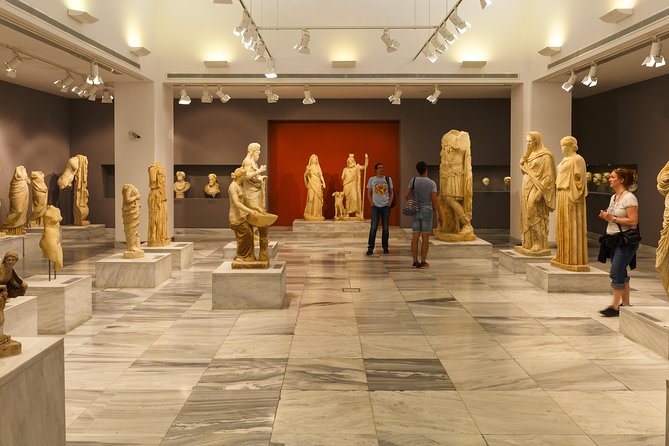
Museo Archeologico di Heraklion
Il Museo Archeologico di Heraklion is located in the center of the city and is one of the most important archaeological museums in the world. It houses an unrivaled collection of artifacts from the Bronze-age Minoan culture – the first of note on what is now European soil and is one of the most important collections of history in Europe and Creta. Gli oggetti esposti coprono un periodo di dieci millenni, dal Neolitico alla tarda età romana.
After a major renovation and expansion, the museum has been fully open to the public since May 2014, with 24 rooms of exhibits on display. A standard tour would start on the Ground floor, the halls are dedicated to the Neolithic and Minoan cultures. Organized chronologically, covering all phases of the Minoan civilization, the rooms direct you from the Prepalatial period (3000 – 1900 BC), through three phases of Palaces, down to the Post-palatial era (1350 – 1000 BC).
The information displays in each room explain the key features of each period – and so the evolution of culture. In these halls, the visitor is held entranced by objects of Minoan art and craft, jewelry and seals, pottery and metalwork, ivory, faience and glass. There are everyday items, as well as those used for religious ceremonies and worship rituals; we also find a great number of items from burial chambers. Interested visitors can read the displays for additional information on the economic, religious and social practices of the time. Among the exhibits are some of the most famous Minoan icons, such as the Snake Goddess, the Disco Phaistos, l'Anello di Minosse e il Mallia ciondolo a forma di vespa (o di ape).
I visitatori del museo possono ammirare i manufatti unici recuperati dagli scavi presso il sito di Palazzi di Cnosso, Phaistos, Agia Triada, Malia e Zakros – as well as the numerous other major centers and sites of Minoan Crete. Past the first floor galleries, the hall is lined with stunning Minoan frescoes. Here we see the Prince of the Lilies, the Ladies in Blue, the Saffron Gatherer and other well-known frescoes. In the adjoining rooms, we find artifacts from the Subminoan and Early Iron Age periods (Proto- and Geometric) and Archaic times, which also come from the island of Crete. Many of these are exhibited for the first time. The collection of the first floor is completed with exhibits of the Classical and Hellenistic years.
Tornando al piano terra, visitate la sala con le sculture che vanno dal Arcaico, al periodo classico e a quello romano. L'edificio originale del museo è stato costruito tra il 1937 e il 1940, su progetto dell'architetto Patroklos Karantinoue ristrutturato nel dopoguerra. L'ultima ristrutturazione ha aumentato notevolmente la superficie disponibile, dando vita a un museo degno del XXI secolo.
Il sito stesso era importante perché qui, durante l'epoca veneziana, si trovava l'importante monastero cattolico romano di San Francesco è stato localizzato.
Nel cimitero sono state sepolte importanti famiglie veneziane e tutti coloro che sono morti durante i 21 anni di assedio ottomano. Il monastero stesso fu distrutto da un terremoto nel 1856.
Per saperne di più sul Museo Archeologico di Heraklion
Indirizzo: Via Xanthoudidou e Hadjidaki
Orari di visita/informazioni:
Martedì-Sabato: 08:00-19:00,
Lunedì e domenica e festivi: 09:00-16:00
Tel: (+30) 2810279000, (+30)2810279086, (+30)2810279087
Fax: (+30)2810279071
Email: amh@culture.gr
*Gli orari di apertura e le informazioni sono soggetti a modifiche.
 IT
IT  EN
EN  DE
DE  FR
FR  NL
NL  PL
PL