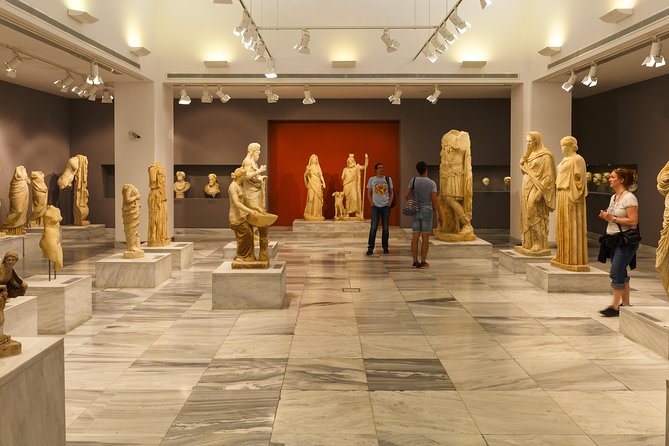
Archeologisch Museum van Heraklion
De Archeologisch Museum van Heraklion is located in the center of the city and is one of the most important archaeological museums in the world. It houses an unrivaled collection of artifacts from the Bronze-age Minoan culture – the first of note on what is now European soil and is one of the most important collections of history in Europe and Kreta. De tentoongestelde voorwerpen bestrijken een periode van tien millennia, van het neolithicum tot de late Romeinse tijd.
After a major renovation and expansion, the museum has been fully open to the public since May 2014, with 24 rooms of exhibits on display. A standard tour would start on the Ground floor, the halls are dedicated to the Neolithic and Minoan cultures. Organized chronologically, covering all phases of the Minoan civilization, the rooms direct you from the Prepalatial period (3000 – 1900 BC), through three phases of Palaces, down to the Post-palatial era (1350 – 1000 BC).
The information displays in each room explain the key features of each period – and so the evolution of culture. In these halls, the visitor is held entranced by objects of Minoan art and craft, jewelry and seals, pottery and metalwork, ivory, faience and glass. There are everyday items, as well as those used for religious ceremonies and worship rituals; we also find a great number of items from burial chambers. Interested visitors can read the displays for additional information on the economic, religious and social practices of the time. Among the exhibits are some of the most famous Minoan icons, such as the Snake Goddess, the Phaistos Schijfde ring van Minos en de Mallia wespen- (of bijen-) hanger.
Bezoekers van het museum kunnen unieke artefacten bewonderen die zijn gevonden bij de opgravingen in de Paleizen van Knossos, Phaistos, Agia Triada, Malia en Zakros – as well as the numerous other major centers and sites of Minoan Crete. Past the first floor galleries, the hall is lined with stunning Minoan frescoes. Here we see the Prince of the Lilies, the Ladies in Blue, the Saffron Gatherer and other well-known frescoes. In the adjoining rooms, we find artifacts from the Subminoan and Early Iron Age periods (Proto- and Geometric) and Archaic times, which also come from the island of Crete. Many of these are exhibited for the first time. The collection of the first floor is completed with exhibits of the Classical and Hellenistic years.
Als je terugkeert naar de begane grond, bezoek dan de hal met beeldhouwwerken variërend van de Archaïschvia de Klassieke naar de Romeinse periode. Het oorspronkelijke museumgebouw werd gebouwd tussen 1937 en 1940, ontworpen door architect Patroklos Karantinouen opgeknapt in de naoorlogse jaren. De meest recente make-over vergrootte de beschikbare ruimte aanzienlijk en leverde een museum op dat de 21e eeuw waardig is.
De plek zelf was van belang omdat hier in de Venetiaanse tijd het belangrijke rooms-katholieke klooster van St. Francis zich bevond.
Opmerkelijke Venetiaanse families werden op de begraafplaats begraven, net als al diegenen die omkwamen tijdens het 21 jaar durende Ottomaanse beleg. Het klooster zelf werd verwoest door een aardbeving in 1856.
Lees meer over de Archeologisch Museum van Heraklion
Adres: Xanthoudidou & Hadjidaki Straat
Bezoekuren/info:
Dinsdag t/m zaterdag: 08:00-19:00,
Maandag & zondag & feestdagen: 09:00-16:00
Tel: (+30) 2810279000, (+30)2810279086, (+30)2810279087
Fax: (+30)2810279071
E-mail: amh@culture.gr
*Openingstijden en informatie onder voorbehoud.
 NL
NL  EN
EN  DE
DE  FR
FR  IT
IT  PL
PL