Muzeum Archeologiczne w Heraklionie
The Muzeum Archeologiczne w Heraklionie is located in the center of the city and is one of the most important archaeological museums in the world. It houses an unrivaled collection of artifacts from the Bronze-age Minoan culture – the first of note on what is now European soil and is one of the most important collections of history in Europe and Kreta. Eksponaty obejmują okres dziesięciu tysiącleci, od epoki neolitu do późnych czasów rzymskich.
After a major renovation and expansion, the museum has been fully open to the public since May 2014, with 24 rooms of exhibits on display. A standard tour would start on the Ground floor, the halls are dedicated to the Neolithic and Minoan cultures. Organized chronologically, covering all phases of the Minoan civilization, the rooms direct you from the Prepalatial period (3000 – 1900 BC), through three phases of Palaces, down to the Post-palatial era (1350 – 1000 BC).
The information displays in each room explain the key features of each period – and so the evolution of culture. In these halls, the visitor is held entranced by objects of Minoan art and craft, jewelry and seals, pottery and metalwork, ivory, faience and glass. There are everyday items, as well as those used for religious ceremonies and worship rituals; we also find a great number of items from burial chambers. Interested visitors can read the displays for additional information on the economic, religious and social practices of the time. Among the exhibits are some of the most famous Minoan icons, such as the Snake Goddess, the Dysk PhaistosPierścień Minosa i Mallia wisiorek z osą (lub pszczołą).
Odwiedzający muzeum mogą podziwiać unikalne artefakty odzyskane z wykopalisk w Pałace w Knossos, Phaistos, Agia Triada, Malia oraz Zakros – as well as the numerous other major centers and sites of Minoan Crete. Past the first floor galleries, the hall is lined with stunning Minoan frescoes. Here we see the Prince of the Lilies, the Ladies in Blue, the Saffron Gatherer and other well-known frescoes. In the adjoining rooms, we find artifacts from the Subminoan and Early Iron Age periods (Proto- and Geometric) and Archaic times, which also come from the island of Crete. Many of these are exhibited for the first time. The collection of the first floor is completed with exhibits of the Classical and Hellenistic years.
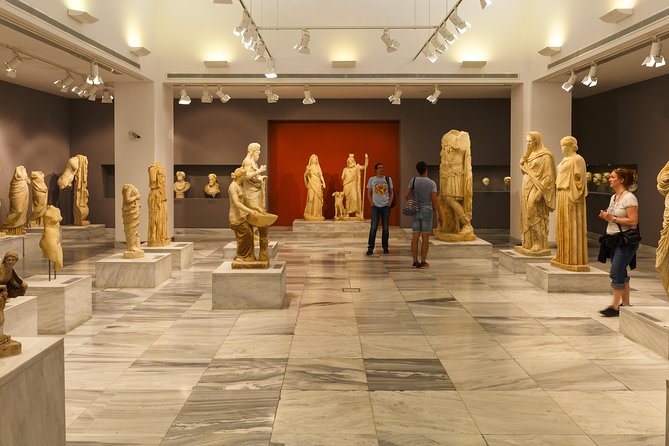
Wracając na parter, odwiedź salę wyłożoną rzeźbami, począwszy od Archaicznypoprzez okres klasyczny aż do okresu rzymskiego. Oryginalny budynek muzeum został zbudowany w latach 1937-1940, zaprojektowany przez architekta Patroklos Karantinoui odnowione w latach powojennych. Ostatnia modernizacja znacznie zwiększyła dostępną powierzchnię, tworząc muzeum godne XXI wieku.
Samo miejsce miało duże znaczenie, ponieważ to właśnie tutaj w czasach weneckich znajdował się ważny rzymskokatolicki klasztor Święty Franciszek został zlokalizowany.
Na cmentarzu pochowano znane weneckie rodziny, a także wszystkich tych, którzy zginęli podczas 21-letniego oblężenia osmańskiego. Sam klasztor został zniszczony przez trzęsienie ziemi w 1856 roku.
Przeczytaj więcej o Muzeum Archeologiczne w Heraklionie
Adres: Xanthoudidou & Hadjidaki Street
Godziny odwiedzin/informacje:
Wtorek-sobota: 08:00-19:00,
Poniedziałek i niedziela oraz święta: 09:00-16:00
Tel: (+30) 2810279000, (+30)2810279086, (+30)2810279087
Faks: (+30)2810279071
E-mail: amh@culture.gr
*Godziny otwarcia i informacje mogą ulec zmianie.
 PL
PL  EN
EN  DE
DE  FR
FR  IT
IT  NL
NL