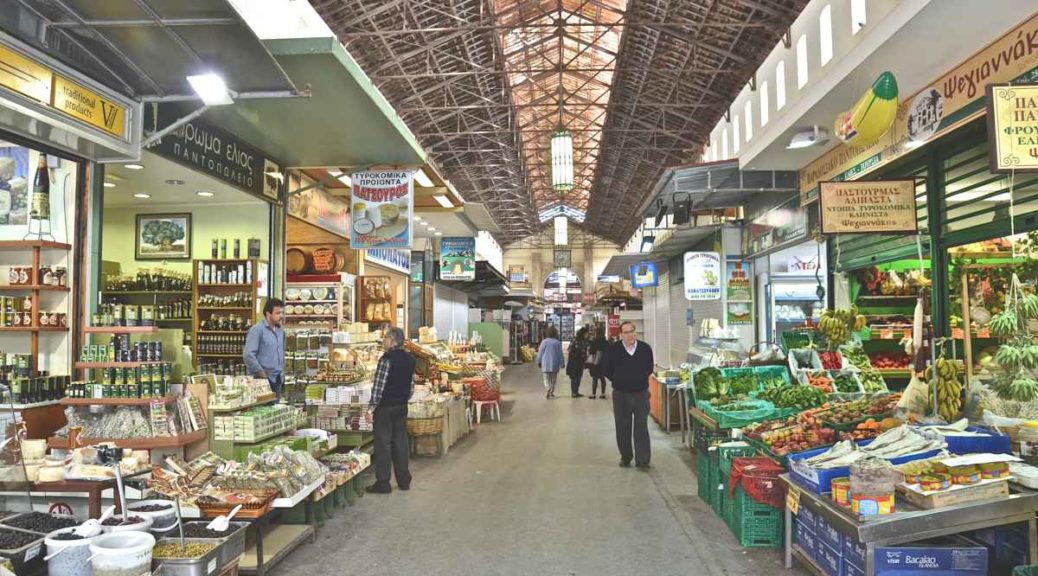
Municipal Market of Chania – Crete
The Rynek miejski w Chanii to szczególnie żywe miejsce, pełne kolorów, zapachów i ciągłego ruchu, które oprócz tego, że jest popularną atrakcją turystyczną, jest nadal wykorzystywane przez mieszkańców.
Jest to również jedna z najważniejszych instytucji stworzonych przez państwo kreteńskie; jego budowa rozpoczęła się w 1911 r. i została ukończona w 1913 r., tak że Eleftherios Venizelos zainaugurowałby go sam, zaledwie trzy dni po ceremonii dla Unia Krety with the rest of Greece. An unofficial open market already existed in the area, where makeshift butchers’ and fishmongers’ stalls, as well as fruit and vegetable stalls, operated. Then, the Władze miejskie postanowił stworzyć Rynek miejski w tej samej lokalizacji, w której znajdowałyby się już istniejące sklepy, dzięki czemu rynek mógłby funkcjonować w bardziej zorganizowany sposób, a obszar zostałby ulepszony. Wymagało to jednak wyburzenia części budynku. Ściany weneckie i Piatta Forma bastion, a także obwałowanie fosy i wywłaszczenie okolicznych terenów.
Budynek Rynek miejski został wymieniony jako zachowany zabytek przez Greckie Ministerstwo Kultury, in 1980. It has a cruciform plan and it reminds one of the “Żeliwna architektura” buildings of the late 19th century. The architecture is typical of the Industrial Revolution era and its designs were modeled after the market in Marseille. It accommodates 76 shops, which at the beginning of its operation were to be found as follows: the eastern and the western section of the market were occupied by the butchers’ shops; at the western end one could find the fishmongers’ shops; at the northern and southern areas, the fruit and vegetable shops. In addition to its initial role as a marketplace, it has been a part of Cretan history in many other ways. Just before the Battle of Crete, an anti-aircraft shelter was made at its south-eastern side, while later, during the German Occupation, the conquerors used it for the needs of their army. Today, it is a lively spot in the heart of the city, where one can buy food, souvenirs, traditional products and folk art items.
 PL
PL  EN
EN  DE
DE  FR
FR  IT
IT  NL
NL