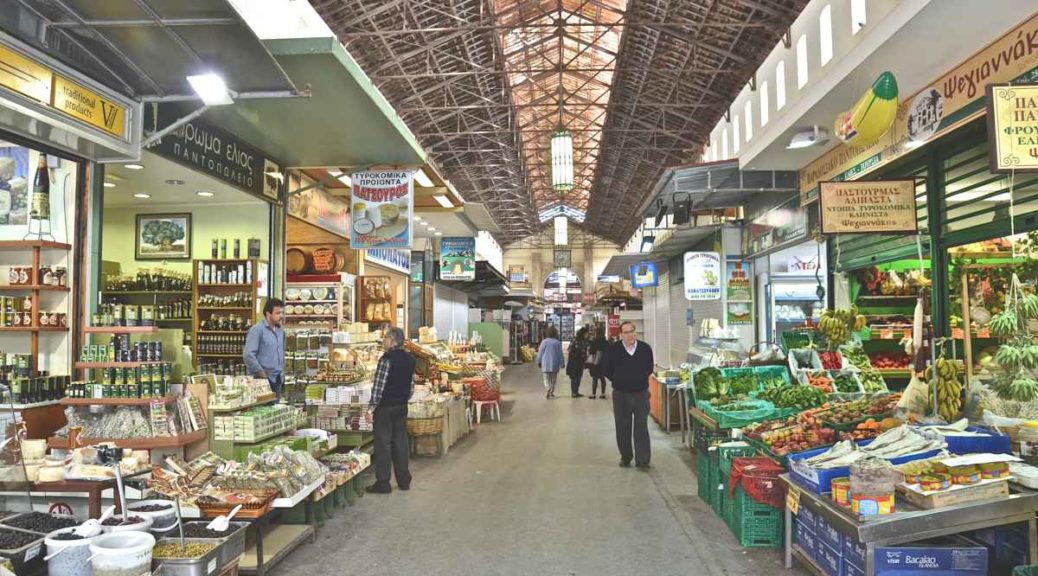
Municipal Market of Chania – Crete
De Gemeentelijke markt van Chania is een bijzonder levendige plek, vol kleuren, geuren en constante beweging, die niet alleen een populaire toeristische attractie is, maar ook nog steeds wordt gebruikt door de lokale bevolking.
Het is ook een van de belangrijkste instellingen van de Kretenzische staat; de bouw ervan begon in 1911 en werd voltooid in 1913, zodat Eleftherios Venizelos het zelf zou inwijden, nauwelijks drie dagen na de ceremonie voor de Unie van Kreta with the rest of Greece. An unofficial open market already existed in the area, where makeshift butchers’ and fishmongers’ stalls, as well as fruit and vegetable stalls, operated. Then, the Gemeentelijke autoriteit besloten om een Gemeentelijke markt op dezelfde locatie, waarin de al bestaande winkels zouden worden ondergebracht, zodat de markt op een meer georganiseerde manier zou kunnen functioneren en het gebied zou worden verbeterd. Hiervoor moest echter een deel van de markt worden afgebroken. Venetiaanse muren en de Piatta Forma bastion, evenals de bedijking van de gracht en de onteigening van het omliggende gebied.
De bouw van de Gemeentelijke markt werd opgenomen in de lijst van beschermde monumenten door de Helleens Ministerie van Cultuur, in 1980. It has a cruciform plan and it reminds one of the “Gietijzeren architectuur” buildings of the late 19th century. The architecture is typical of the Industrial Revolution era and its designs were modeled after the market in Marseille. It accommodates 76 shops, which at the beginning of its operation were to be found as follows: the eastern and the western section of the market were occupied by the butchers’ shops; at the western end one could find the fishmongers’ shops; at the northern and southern areas, the fruit and vegetable shops. In addition to its initial role as a marketplace, it has been a part of Cretan history in many other ways. Just before the Battle of Crete, an anti-aircraft shelter was made at its south-eastern side, while later, during the German Occupation, the conquerors used it for the needs of their army. Today, it is a lively spot in the heart of the city, where one can buy food, souvenirs, traditional products and folk art items.
 NL
NL  EN
EN  DE
DE  FR
FR  IT
IT  PL
PL