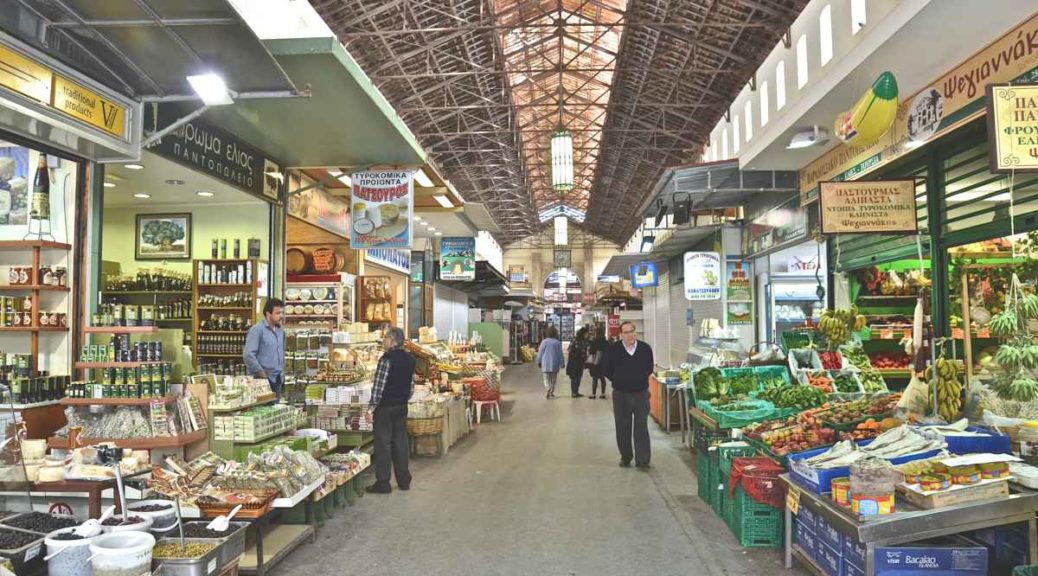
Municipal Market of Chania – Crete
Il Mercato comunale di Chania è un luogo particolarmente vivace, pieno di colori, profumi e costante movimento, che oltre a essere una popolare attrazione turistica è ancora utilizzato dagli abitanti del luogo.
È anche una delle istituzioni più importanti create dallo Stato cretese; la sua costruzione è iniziata nel 1911 ed è stata terminata nel 1913, così che Eleftherios Venizelos avrebbe inaugurato lui stesso, appena tre giorni dopo la cerimonia per l'inaugurazione del Unione di Creta with the rest of Greece. An unofficial open market already existed in the area, where makeshift butchers’ and fishmongers’ stalls, as well as fruit and vegetable stalls, operated. Then, the Autorità comunale ha deciso di creare un Mercato comunale nello stesso luogo, che ospiterebbe i negozi già esistenti, in modo che il mercato possa funzionare in modo più organizzato e l'area venga valorizzata. Tuttavia, ciò richiedeva la demolizione di una parte dell'edificio. Pareti veneziane e il Piatta Forma bastione, nonché l'arginamento del fossato e l'esproprio dell'area circostante.
La costruzione del Mercato comunale è stato classificato come monumento conservato dal Ministero della Cultura ellenico, in 1980. It has a cruciform plan and it reminds one of the “Architettura in ghisa” buildings of the late 19th century. The architecture is typical of the Industrial Revolution era and its designs were modeled after the market in Marseille. It accommodates 76 shops, which at the beginning of its operation were to be found as follows: the eastern and the western section of the market were occupied by the butchers’ shops; at the western end one could find the fishmongers’ shops; at the northern and southern areas, the fruit and vegetable shops. In addition to its initial role as a marketplace, it has been a part of Cretan history in many other ways. Just before the Battle of Crete, an anti-aircraft shelter was made at its south-eastern side, while later, during the German Occupation, the conquerors used it for the needs of their army. Today, it is a lively spot in the heart of the city, where one can buy food, souvenirs, traditional products and folk art items.
 IT
IT  EN
EN  DE
DE  FR
FR  NL
NL  PL
PL