Museo Archeologico di Agios Nikolaos
Il Museo Archeologico di Agios Nikolaos è stata fondata nel 1970 per esporre i numerosi reperti provenienti dall'est Creta che fino a quel momento erano esposti al Museo di Heraklion. La mostra copre il periodo che va dal Neolitico alla fine del periodo greco-romano. È suddivisa in cinque sale e il visitatore può seguire l'evoluzione dell'arte nella zona attraverso campioni rappresentativi di diverse tecniche ed epoche.
Nella prima sala, spicca la statuetta a forma di fallo proveniente dalla grotta di Pelekiti di Zakros. In mostra anche le offerte rinvenute nel 1971 nel cimitero di mare di Agia Fotia. This cemetery, the largest in its number of tombs in prehistoric Crete and one of the largest in Greece, had at least 260 graves with over 1,600 vessels, bronze artefacts and blades (3,000 – 2,300 BC). Moving on to the second room we meet the most famous object of the Museum `La dea di Myrtos”. It is an exquisite vessel shaped in the form of a female figure with a very small head on a tall, slender neck and a bell-shaped body. Both hands are used to hold together the spout or nozzle of the jug from where the liquid contained within would have flowed. Gold jewerly, and various other stone vessels from the early Minoan cemetery (2600 – 2000 BC) are exhibited in this gallery.
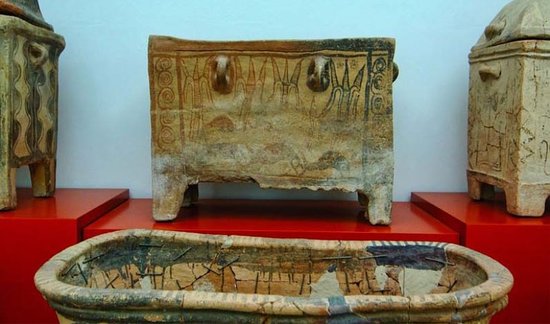
The third room is dedicated to the Neo-Palatial period (1700-1450 BC) with sarcophagi of the neo-Palatial and the post-Palatial period on display. In the fourth room, we find a child’s burial pithos from the New Palace Period that was discovered and is exhibited in its entirety. Many samples of Late Minoan pottery and everyday items including a potter’s wheel are on display in the same room.
In the last rooms of the museum, the characteristics of the Daedalic style, in ceramic art and stone sculpture are highlighted and explained. The Dedalico Lo stile di scultura greco-romano scomparve gradualmente e lasciò il posto a quello arcaico. Infine, i reperti del periodo greco-romano sono esposti nella Sala 7. Uno dei reperti più suggestivi di questa sala è il cranio di un giovane atleta, trovato con una corona d'oro (probabilmente proveniente da un albero di ulivo) e una moneta ancora in bocca. Il cranio è stato rinvenuto nel cimitero romano di Potamos, vicino alla città di Agios Nikolaos and is from the first century AD. The coin is characteristic of “Charon’s obol“, placed in the mouth as payment to the ferryman, Caronteper assicurarsi il passaggio nell'aldilà.
 IT
IT  EN
EN  DE
DE  FR
FR  NL
NL  PL
PL