Muzeum Archeologiczne w Agios Nikolaos
The Muzeum Archeologiczne w Agios Nikolaos została założona w 1970 roku, aby prezentować liczne znaleziska ze wschodniej Kreta które do tej pory były wyświetlane na Muzeum w Heraklionie. Wystawa obejmuje okres od neolitu do końca okresu grecko-rzymskiego. Jest podzielona na pięć sal, a zwiedzający mogą śledzić ewolucję sztuki na tym obszarze poprzez reprezentatywne próbki różnych technik i epok.
W pierwszym pomieszczeniu wyróżnia się figurka w kształcie fallusa pochodząca z jaskini Pelekici z Zakros. Na wystawie prezentowane są również ofiary znalezione w 1971 roku na nadmorskim cmentarzu Agia Fotia. This cemetery, the largest in its number of tombs in prehistoric Crete and one of the largest in Greece, had at least 260 graves with over 1,600 vessels, bronze artefacts and blades (3,000 – 2,300 BC). Moving on to the second room we meet the most famous object of the Museum `Bogini Myrtos”. It is an exquisite vessel shaped in the form of a female figure with a very small head on a tall, slender neck and a bell-shaped body. Both hands are used to hold together the spout or nozzle of the jug from where the liquid contained within would have flowed. Gold jewerly, and various other stone vessels from the early Minoan cemetery (2600 – 2000 BC) are exhibited in this gallery.
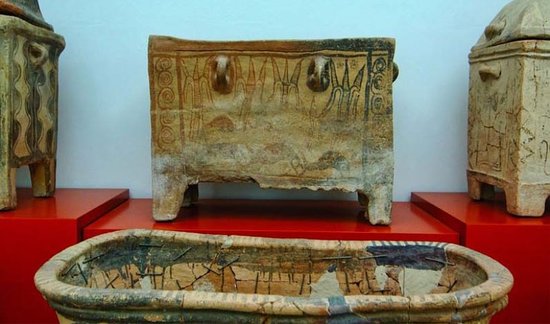
The third room is dedicated to the Neo-Palatial period (1700-1450 BC) with sarcophagi of the neo-Palatial and the post-Palatial period on display. In the fourth room, we find a child’s burial pithos from the New Palace Period that was discovered and is exhibited in its entirety. Many samples of Late Minoan pottery and everyday items including a potter’s wheel are on display in the same room.
In the last rooms of the museum, the characteristics of the Daedalic style, in ceramic art and stone sculpture are highlighted and explained. The Daedalic Styl ten stopniowo zanikał i ustąpił miejsca archaicznemu stylowi rzeźby. Wreszcie, znaleziska z okresu grecko-rzymskiego są eksponowane w sali 7. Jednym z najbardziej uderzających eksponatów w tej sali jest czaszka młodego atlety, znaleziona ze złotym wieńcem (prawdopodobnie z drzewa oliwnego) i monetą wciąż w ustach. Czaszka została znaleziona na rzymskim cmentarzu w Potamosw pobliżu miasta Agios Nikolaos and is from the first century AD. The coin is characteristic of “Charon’s obol“, placed in the mouth as payment to the ferryman, Charonaby zapewnić sobie przejście do zaświatów.
 PL
PL  EN
EN  DE
DE  FR
FR  IT
IT  NL
NL