Archeologisch Museum van Agios Nikolaos
De Archeologisch Museum van Agios Nikolaos werd opgericht in 1970 om de vele vondsten uit oostelijke Kreta die tot dan toe werden getoond in de Museum van Heraklion. De tentoonstelling beslaat de periode van het neolithicum tot het einde van de Grieks-Romeinse periode. Het is verdeeld in vijf zalen en de bezoeker kan de evolutie van de kunst in het gebied volgen aan de hand van representatieve voorbeelden van verschillende technieken en tijdperken.
In de eerste kamer is een hoogtepunt dat opvalt het fallusvormige beeldje uit de grot van Pelekieten van Zakros. Er zijn ook offers te zien die in 1971 zijn gevonden op de begraafplaats aan zee van Agia Fotia. This cemetery, the largest in its number of tombs in prehistoric Crete and one of the largest in Greece, had at least 260 graves with over 1,600 vessels, bronze artefacts and blades (3,000 – 2,300 BC). Moving on to the second room we meet the most famous object of the Museum `De godin van Myrtos”. It is an exquisite vessel shaped in the form of a female figure with a very small head on a tall, slender neck and a bell-shaped body. Both hands are used to hold together the spout or nozzle of the jug from where the liquid contained within would have flowed. Gold jewerly, and various other stone vessels from the early Minoan cemetery (2600 – 2000 BC) are exhibited in this gallery.
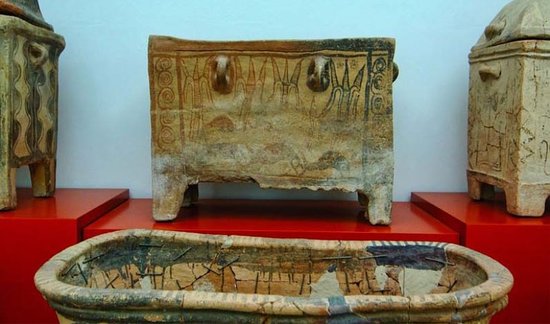
The third room is dedicated to the Neo-Palatial period (1700-1450 BC) with sarcophagi of the neo-Palatial and the post-Palatial period on display. In the fourth room, we find a child’s burial pithos from the New Palace Period that was discovered and is exhibited in its entirety. Many samples of Late Minoan pottery and everyday items including a potter’s wheel are on display in the same room.
In the last rooms of the museum, the characteristics of the Daedalic style, in ceramic art and stone sculpture are highlighted and explained. The Daedalisch stijl verdween geleidelijk en maakte plaats voor de Archaïsche beeldhouwstijl. Tot slot worden vondsten uit de Grieks-Romeinse periode tentoongesteld in zaal 7. Een van de opvallendste voorwerpen in deze zaal is de schedel van een jonge atleet, gevonden met een gouden krans (waarschijnlijk van een olijfboom) en een muntstuk nog in zijn mond. De schedel werd gevonden op de Romeinse begraafplaats in Potamos, in de buurt van de stad Agios Nikolaos and is from the first century AD. The coin is characteristic of “Charon’s obol“, placed in the mouth as payment to the ferryman, Charonom de doorgang naar het hiernamaals veilig te stellen.
 NL
NL  EN
EN  DE
DE  FR
FR  IT
IT  PL
PL