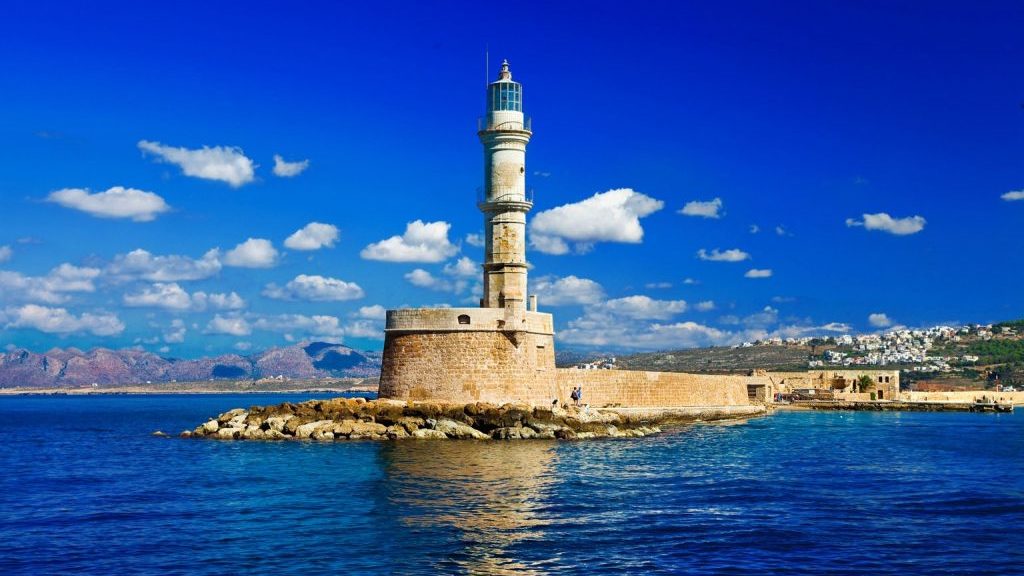
The Venetian Port & Lighthouse – Chania
Spis treści
Port wenecki
Wenecki port w Chanii, w tym wenecka latarnia morska, jest jednym z symboli miasta i ulubionym miejscem spacerów zarówno mieszkańców, jak i turystów.
Jego pierwotna konstrukcja została zbudowana w latach 1320-1355; później, w latach 1353-1364, został porzucony, ponieważ był zbyt płytki i zbyt narażony na silne północne i zachodnie wiatry. Od tego czasu port w Heraklionie, który był większy, został uznany za najważniejszy w kraju. Kreta. Upadek portu Chania Trwało to do upadku miasta na rzecz Turków w 1645 r.; zdobywcy nie angażowali się w jego utrzymanie ani naprawę. Ostatecznie było to Muhammad Aliwicekról Egipt (Kreta w latach 1831-1841 znajdował się pod panowaniem egipskim), który zdawał sobie sprawę ze znaczenia portu dla lokalnej gospodarki. Z tego powodu naprawił molo i przeprowadził prace pogłębiarskie, które zostały zakończone w okresie państwa kreteńskiego.
Latarnia morska w Chanii
Latarnia morska Chania differs from others of its time and cannot be classified in any standard lighthouse category. The architecture reminds one of a minaret, and it does not include a lighthouse keeper sleeping quarters, given the fact that it is located in an inhabited area. It is 21 metres high, its beam could reach a distance of 7 miles, and it is one of the oldest lighthouses of Europe, if not the entire world. Τhe foundations were laid by the Venetians on natural rock, between 1595 and 1601. Many of its characteristics remind one of the local, Venetian architecture. The material used for building the city walls was also used for the construction of the lighthouse, which has an octagonal base, a 16-corner middle section and another, circular section. In 1839 it was upgraded with the latest lighthouse technology of the time. The stairway of the eastern side and the peripheral parapet are Turkish additions.
Arsenały weneckie
Weneckie stocznie (Arsenali, in Italian) were used for the repairing of ships during the winter, in the years of the Venetian rule. The largest complex was built between 1526 and 1599 and it consisted of 17 vaulted constructions or domes. The Moro arsenals, “Neoria” (named after the governor or Provveditore Generale) were built in 1607. Only two of them survive entirely today after the third one collapsed during the bomb-raids of 1941. Nowadays, a group of 7 continuous domes is preserved-along with another one further to the west, the “Grand Arsenal” (today, the Centre of Mediterranean Architecture). Only two “Neoria” are preserved intact from “Moro” complex, at the heart of the port, while in the position of the demolished “Neoria“, the stone building of the new customs of Chania was constructed, which is today surrounded by two squares.
Z największego kompleksu arsenałów zachowało się 7 kopuł oraz Megalo Arsenali (= duży arsenał), w którym mieści się Centrum Architektury Śródziemnomorskiej. Reszta została zburzona podczas okupacji tureckiej, kiedy rola portu została już zmniejszona, a utrzymanie było słabe. Te, które przetrwały, były wykorzystywane jako magazyny wojskowe.
Aby zrozumieć pierwotne przeznaczenie arsenałów, trzeba wiedzieć, że były one otwarte na morze, a woda wpływała do nich do pewnego punktu. Były one połączone łukowatymi otworami, a można było do nich wejść przez jedną z dwóch bram; główne wejście znajdowało się mniej więcej pośrodku. Część tej bramy przetrwała do dziś, na końcu Ulica Daskalogianni. Obecnie arsenały są często wykorzystywane do nowych celów. Imponujące Moroktóry został odrestaurowany w latach 2009-2010, jest główną siedzibą Klub Żeglarski Chania, a także jedno z najważniejszych miejsc kulturalnych miasta. Często odbywają się tu wystawy, spektakle, warsztaty, pokazy filmowe itp.
 PL
PL  EN
EN  DE
DE  FR
FR  IT
IT  NL
NL