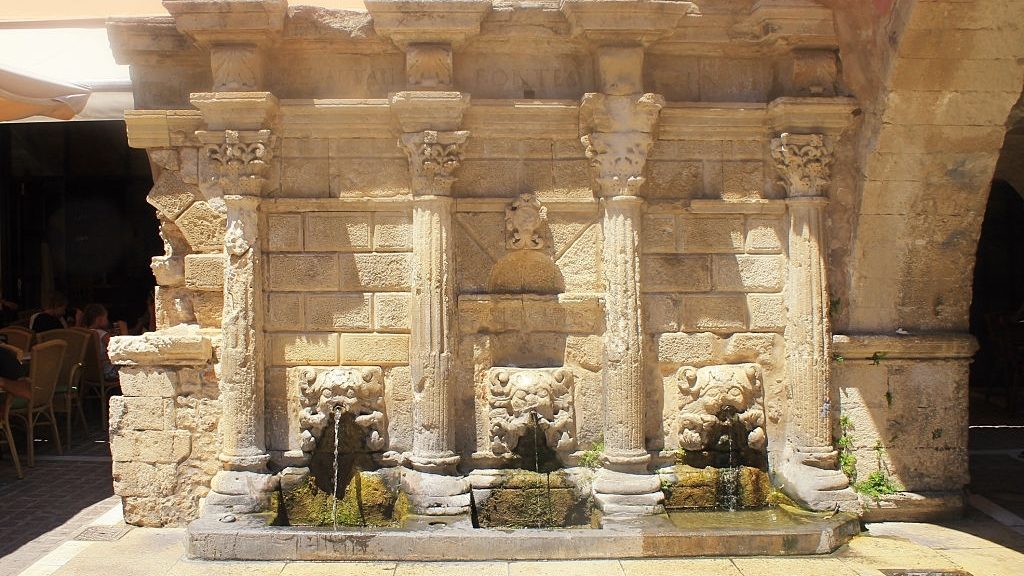
Rimondi Fountain – Rethymno
Il Fontana Rimondi è una delle attrazioni più conosciute della città di Rethymno, compreso il Porta Guora, il Torre dell'orologio (che purtroppo non esiste più) e il Kara Musa Phasha moschea. Il città di Creta hanno sempre avuto un problema di approvvigionamento idrico, che i veneziani affrontarono costruendo acquedotti e fontane.
Oggi nella città di Rethymno sono conservate otto fontane, di cui solo una sopravvive dagli anni veneziani ed è nientemeno che la fontana di Rethymno. Fontana Rimondi, or “Vrysakia” as the locals call it. According to a legend, drinking from the fountain will guarantee eternal youth.
La fontana è stata costruita da, e prende il nome dal Rettore (comandante) di Rethymno, A. Rimandi e si trovava nel cuore della città, presso l'attuale Piazza Petichaki. It covered a significant part of the town’s water needs and was built in 1626. It consists of three troughs from where the water runs respectively into three taps in the shape of a lion’s head. Four ribbed columns ending in Corinthian capitals support a Latin inscription, while behind the fountain is the small tank that supplies water to the taps. Later, during the Turkish occupation, a hemispherical dome was added over the fountain, from which one pillar is still preserved. “Vrysakia” remains a typical, as well as well-photographed corner of the old town and a favourite meeting point of the people of Rethymno.
Walking around the Old Town of Rethymno is one of the best ways to get to know the area. The most important sights are arguably found around the “Città vecchia”. You will discover its narrow alleyways, picturesque corners, architectural treasures, old mansions and distinct traces of the conquerors who passed through here. Very close to the fountain, we find the Marine Life Museum that displays a part of the massive collection that belongs to Museo Moschakio di Atene così come il Museo Storico e del Folklore di Rethymno. Il museo è ospitato all'interno di un palazzo veneziano del XVII secolo restaurato e la collezione proviene da donazioni e acquisti. La collezione conta oltre 5.000 oggetti. Le aree espositive permanenti si estendono in cinque sale e comprendono soprattutto oggetti di artigianato tradizionale e di arte popolare.
 IT
IT  EN
EN  DE
DE  FR
FR  NL
NL  PL
PL