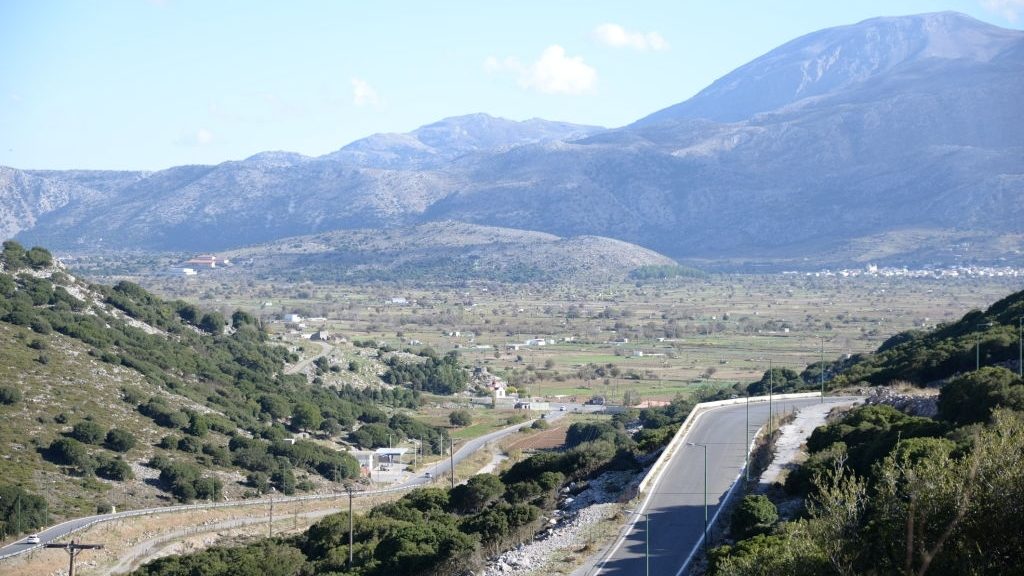
Osada minojska w Karfi
Karfi jest szczególnie ważną starożytną osadą minojską po wschodniej stronie siodła Ambelos (Seli). Osada została zbudowana po wschodniej stronie szczytu Karfi i pokrył cały płaski obszar pomiędzy szczytami Mikri Koprana oraz Megali Koprana. Według archeologów zamieszkiwało ją około 3.500 osób.
Stanowisko archeologiczne znajduje się 50 km od Heraklion i 44 km od Agios Nikolaos na wschodzie. Nazwa Karfi is modern, given to the location due to the spiky rock formations at the top of the summit (karfi = nail in Greek). The ancient name of the site is not known. Karfi is also part of the E4 Europejski długodystansowy szlak pieszy. Można do niego dotrzeć pieszo z wioski Tzermiado podążając ścieżką przez płaskowyż Nissimos.
Uważa się, że osada została założona przez ludność minojską, która musiała uciekać na obszary górskie, ponieważ była prześladowana przez Dorycki plemion, które najechały wyspę. Zostało założone około 1100 r. p.n.e., choć w tym samym miejscu istniało już sanktuarium szczytowe. Archeologiczne znaczenie tego miejsca zostało początkowo zauważone przez Arthur Evansktóry jest najbardziej znany ze swojego odkrycia Knossos. Jednakże, rozliczenie Karfi została odkryta przez angielskiego archeologa John Pendlebury. One of the most remarkable finds from the site is a goddess figurine. The arms are raised in praying or a blessing position, and she has a tubular torso, fixed legs and a bird on top of her head. No other important finds were found, probably due to the fact that the settlement was not destroyed suddenly, but gradually abandoned. As a result, most residents most likely took their belongings away with them. Τhe paved alleys of the settlement, which bring to mind the present-day architecture that can be seen in the villages of Eastern Crete, are quite interesting. The ancient settlement was supplied by the nearby Vitsilovrisi spring, also known as “the spring of the vultures”; it must have supplied a larger quantity of water back then than it does today.
 PL
PL  EN
EN  DE
DE  FR
FR  IT
IT  NL
NL